
A repositioned sofa, a wall repainted in an unexpected shade, a changed light fixture: sometimes, three actions are enough to transform the perception of an entire room. Interior decoration does not rely on an unlimited budget, but on precise choices that take into account light, volumes, and materials. This article explores concrete ways to rethink your living space with coherence.
Emission labels and finish choices: decorating without polluting indoor air
Have you ever noticed the small colored label on a paint pot or a roll of flooring? Since 2013, construction and decoration products sold in France carry an indoor air emission label, rated from A+ (very low emissions) to C (high emissions).
This rating applies to paints, varnishes, adhesives, wallpapers, and laminate floors. Systematically choosing products rated A+ is not a technical detail reserved for construction sites: it is a comfort criterion that influences daily air quality.
In practice, this guides your decor purchases simply. Before falling for a wall paint or glued parquet, check the packaging. If the rating drops below A, consider an alternative. Low-emission ranges have expanded, including vibrant shades and satin finishes.
Exploring interior decoration with Cherry Déco allows you to find references that combine aesthetics and healthier material choices for your home.
Modular furniture: adapting a room for multiple uses without changing everything
A living room that also serves as an office, a guest room that becomes a playroom on Monday mornings: domestic uses change throughout the day. Competing articles often advise optimizing space, but without explaining how a piece of furniture can support this flexibility.
Modular furniture consists of blocks that can be assembled and reconfigured. A sofa made of independent modules transforms into a chaise longue in the evening and a compact seat for a video conference in the morning. Shelves on wheels serve as a temporary partition between a work corner and a relaxation area.
Three criteria for choosing modular furniture
- The compatibility of elements with each other: check that the modules attach securely and that the manufacturer offers extensions for future evolution
- The unit weight of each block: if you need to move an element alone, it should not exceed what you can comfortably carry
- The visual neutrality of the assembly system: visible fixings break the decorative effect, favor invisible connections or those integrated into the structure
This type of furniture is particularly suitable for small spaces, but also for large open areas where defining zones without partitioning remains the main layout challenge.
Reuse and transformation of furniture: personalizing instead of replacing
Thrifting at a flea market is nothing new. What changes is the approach: reuse becomes a full-fledged decoration strategy, not just an economic reflex.
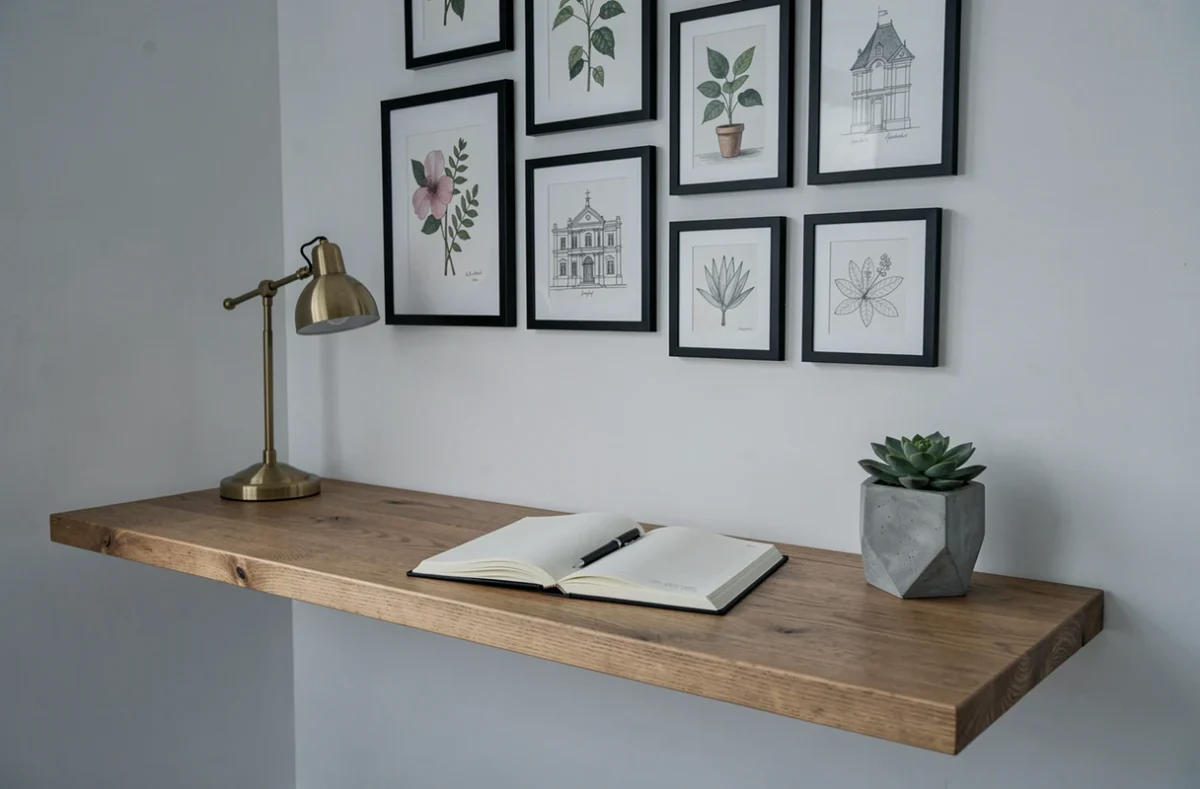
Transforming an existing piece of furniture means giving it a function or appearance it did not have. An old dresser sanded and covered with a low-emission varnish (think A+ label) can become a vanity in a bathroom. A solid wood desk that is too deep can be cut down to form two wall consoles.
Reuse reduces waste and creates unique pieces that no one else owns. It is a much more powerful personalization lever than a purchase from a big box store. Specialized platforms for second-hand furniture have multiplied, making it easier to find characterful pieces.
When recovery doesn’t work
Not all furniture deserves a second life. A particle board swollen by moisture cannot be restored. A sofa with sagging foam will cost more to redo than to replace. Assess the load-bearing structure before diving in: if the solid wood or metal is sound, the rest can be worked on.
Layered lighting: creating an atmosphere without relying solely on the ceiling light
Light is the factor that most alters the perception of an interior, more than wall color or furniture style. Competitors often mention that you need to “multiply light sources,” but without explaining the logic behind it.
The principle is called layered lighting. Each room combines three types of light sources:
- General lighting (ceiling light, pendant) that uniformly covers the room
- Task lighting (desk lamp, reading light, kitchen spots) that targets a specific task
- Ambient lighting (string lights, candles, LED strip behind furniture) that sculpts the atmosphere
Layering these three types allows you to shift from cold, flat light to a warm atmosphere simply by turning off the ceiling light. The living room takes on a whole new dimension when only the accent lamp and an indirect strip light are on.
Also consider the color temperature. A bulb around 2,700 kelvins provides a warm light suitable for living spaces. Above 4,000 kelvins, the light becomes cold and clinical, ideal for a work surface but unpleasant in a bedroom.
Interior decoration gains coherence when each choice, from flooring to bedside lamp, responds to a clear intention. A wall painted with an A+ product, a modular sofa that adapts to your days, a thrifted and reworked piece of furniture, layered lighting: these four axes are enough to transform an interior without overwhelming it. Style arises from the precision of choices, not from their accumulation.