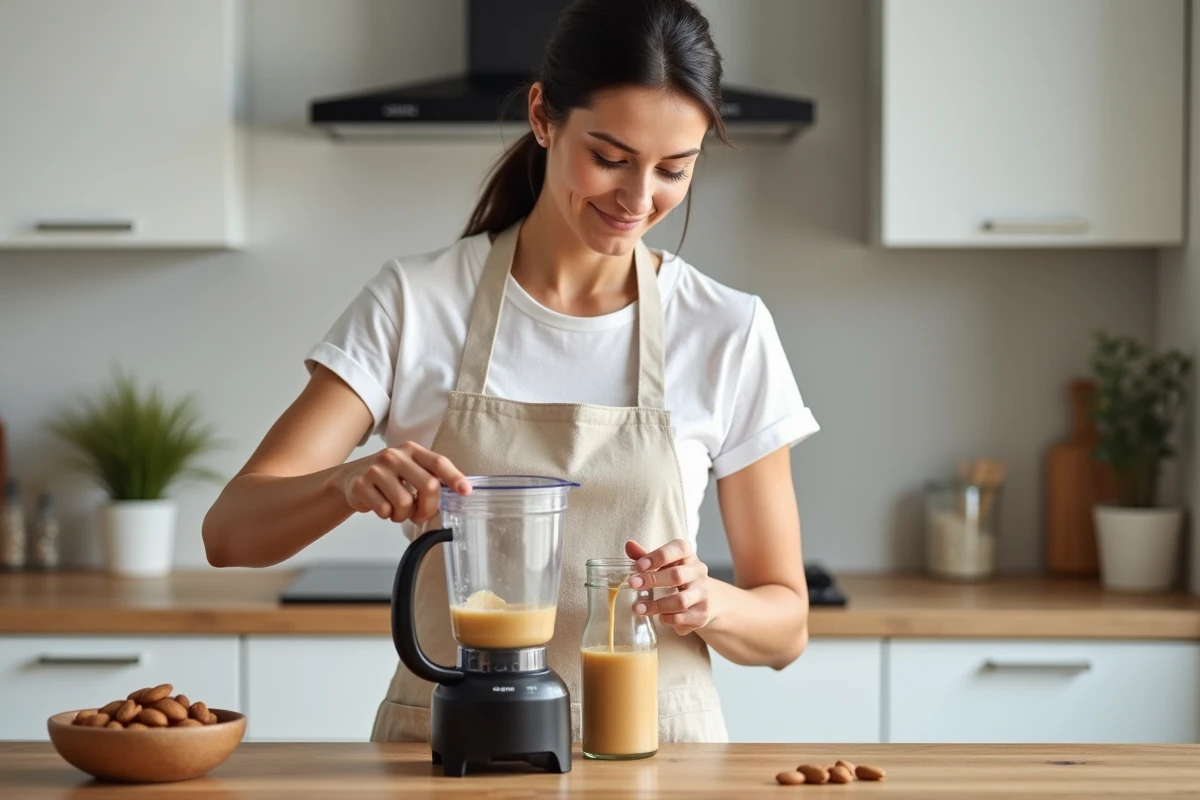
A homemade nut butter boils down to a single operation: grinding dried fruits until their natural oil is released and forms a smooth paste. The difficulty lies in the grinding duration, often several continuous minutes, which puts the motor and blades to the test far beyond what a simple smoothie requires. The choice of blender determines both the texture achieved and the preservation of nutrients, particularly heat-sensitive fatty acids.
Overheating and healthy fats: the parameter most guides overlook
Grinding almonds, hazelnuts, or cashews for several minutes generates intense friction in the bowl. This friction produces heat, which is directly transferred to the preparation. The unsaturated fatty acids contained in nuts, particularly omega-9 and omega-6, degrade when exposed to prolonged temperatures.
For those following a ketogenic or gluten-free diet, nut butters represent a nutritional cornerstone. The quality of the fats consumed has a direct impact on the benefits of these preparations. Overheating alters healthy fats without the texture revealing it.
Two elements of the blender influence the temperature rise. The motor, first: an undersized motor runs faster and longer to compensate for its lack of torque, which increases the heat transferred to the bowl. The blades, next: poorly designed blades crush instead of slice, creating more friction. A suitable appliance allows for making the butter in short bursts, with pauses between each cycle, to limit overheating.
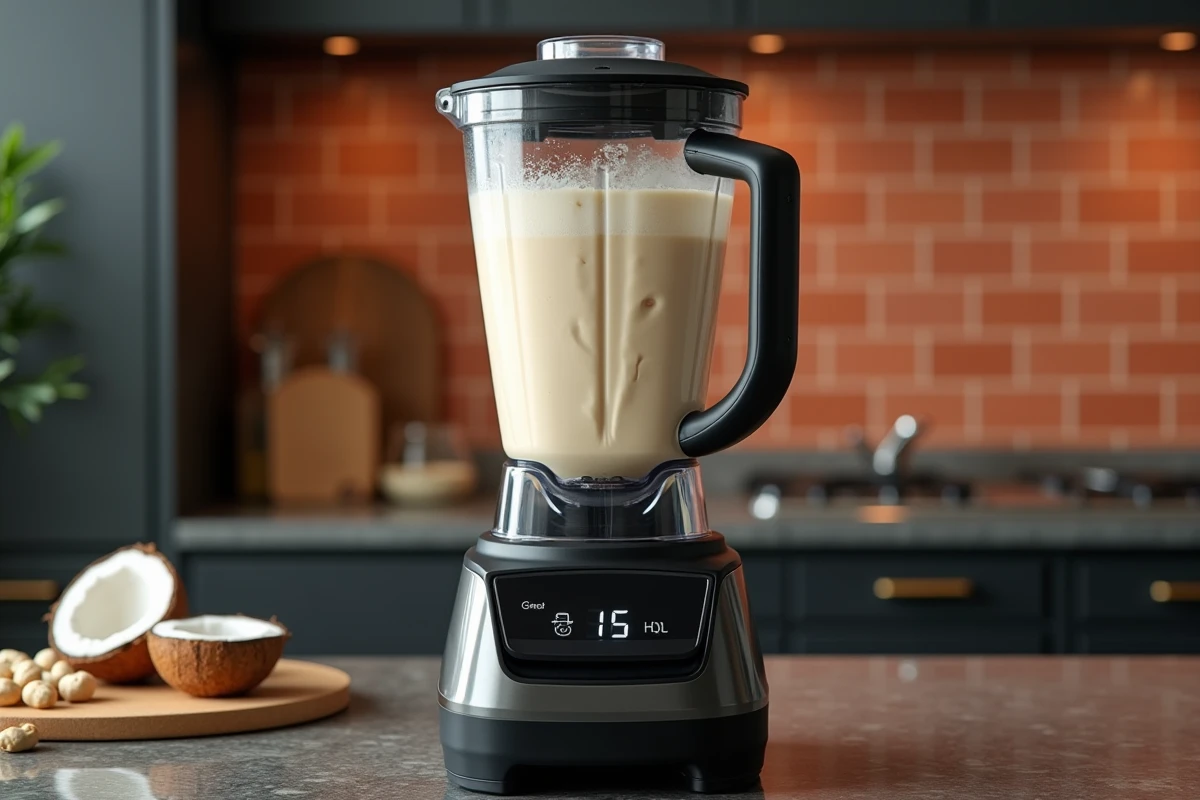
In practice, working in bursts of twenty to thirty seconds, interspersed with pauses, better protects the nutrients than a long continuous cycle. Choosing a blender for nut butter thus involves assessing its ability to provide sufficient motor torque without overheating, rather than relying solely on the power displayed in watts.
Motor power and torque: what really matters for nuts
The power displayed on a blender’s packaging reflects the motor’s electrical consumption. This figure does not directly reflect the mechanical force transmitted to the blades. Motor torque determines the ability to grind dense materials like whole almonds or hazelnuts.
A high-power motor but with low torque will spin quickly in the void when faced with a compact load of nuts. The bowl fills with unground pieces, the preparation stagnates, and the temptation to extend the cycle exacerbates the overheating problem described above.
Classic blender or super blender for thick purees
Classic blenders, designed for liquid preparations like smoothies, have fine blades and a motor optimized for low-resistance mixtures. When faced with dry nuts, their motor struggles and their blades slip.
Super blenders (Vitamix, Omniblend, and equivalents) feature a high-torque motor and thick blades that create a vortex pulling the material toward the center of the bowl. This design allows for transitioning from whole nuts to a smooth puree without constant manual intervention.
- A classic blender requires scraping the walls every thirty seconds and breaking the grinding into many steps, which extends the total time.
- A super blender processes the same amount in a few short cycles, thanks to the shape of the bowl (often narrow at the base) that forces the material toward the blades.
- A multifunction robot with a wide bowl can grind nuts, but the material spreads instead of converging, resulting in a less homogeneous outcome for smooth purees.
Bowl shape and blades: two technical criteria to evaluate before purchase
The geometry of the bowl plays a role as crucial as the motor. A narrow bowl at the base and flared at the top creates a natural circulation of the material. The ground nuts rise along the walls and fall back toward the blades, ensuring uniform grinding.
A wide, flat bowl forces you to work in small quantities to prevent the material from sticking to the walls, out of reach of the blades. This point is often overlooked, as product sheets highlight the total capacity of the bowl without specifying whether this capacity is usable for thick preparations.
Blade material and durability
Blades made of hardened stainless steel resist the abrasion of hard nuts (whole almonds with skin, roasted hazelnuts). Finer blades or standard steel dull after a few months of regular use, which degrades the quality of grinding and increases preparation time.
The configuration of the blades also matters. Multi-level blades (two tiers) stir the material throughout the height of the bowl, while flat blades only work at the bottom. For nut butters, the tiered version significantly reduces the number of cycles needed.

Adapting your blender to keto and gluten-free diets
Nut butters serve as a base for many recipes in restrictive diets: spreads, sauces, crusts without wheat flour. The quality of the puree obtained conditions the success of these preparations.
On a ketogenic diet, almond or macadamia nut butter replaces carbohydrate binders. A grainy texture compromises the hold of a dough or the consistency of a sauce. The blender must therefore produce a perfectly smooth puree in a limited time, without heat altering the lipid profile.
- Favor an appliance capable of operating in short bursts with a gradual speed controller, to adjust the power for each type of nut.
- Check that the bowl disassembles easily for thorough cleaning, to avoid any cross-contamination with gluten-containing preparations.
- Start testing with fatty nuts (cashews, peanuts) that release their oil more quickly, before moving on to almonds or hazelnuts, which are more demanding on the motor.
The speed controller is the most underestimated criterion for nut butters. Starting at low speed to crush, then gradually increasing, stresses the motor evenly and reduces overheating compared to a direct start at full power.
The last point to check remains the motor warranty. An appliance used regularly for nut butters undergoes a mechanical load much greater than that of smoothie use. Some super blender manufacturers offer long warranties on the motor block, reflecting the actual robustness of the device and protecting a significant investment.